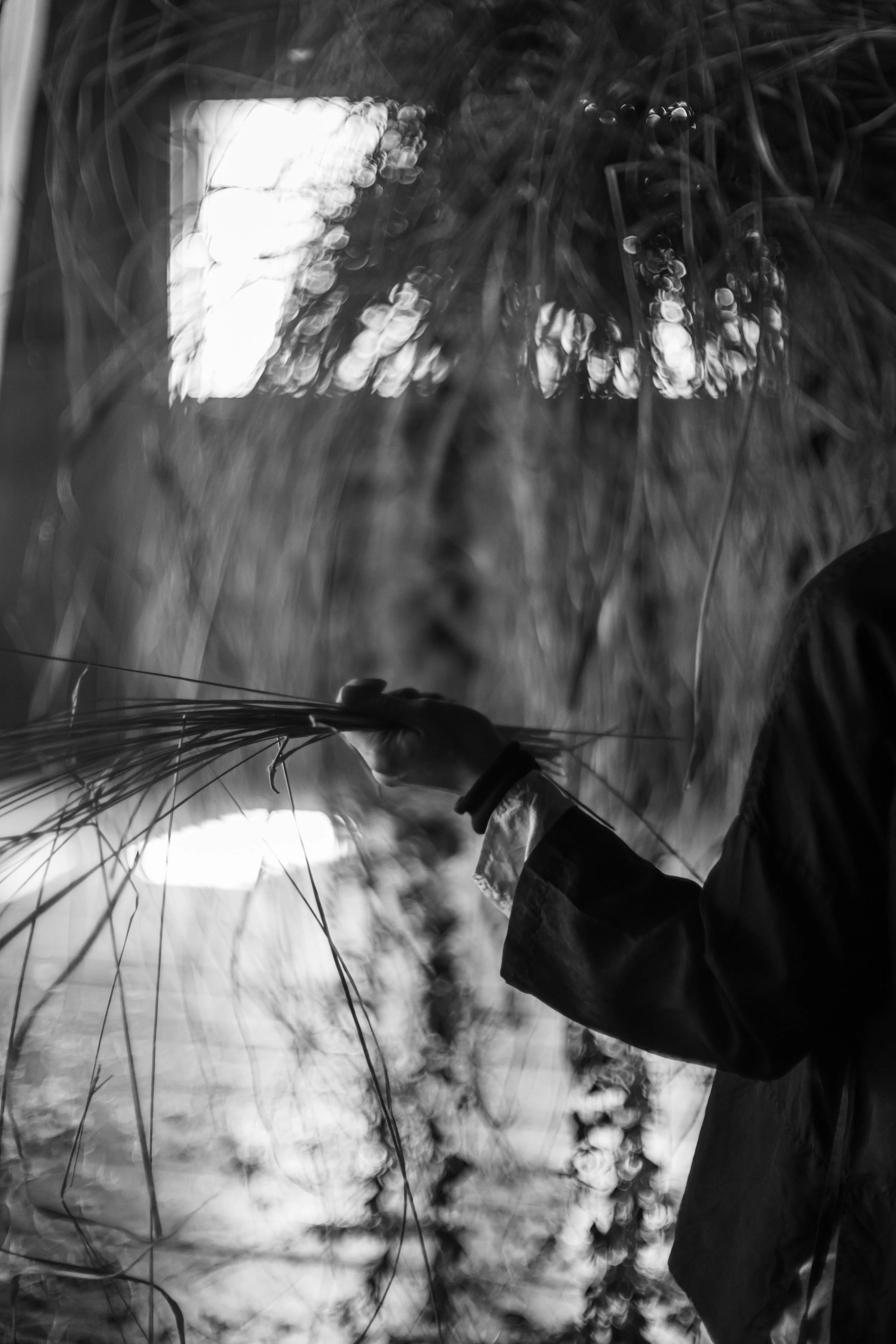
安東英花は、彼女にしかない視点を持つ。
その視点を手がかりとして、
彼女は植物に触れる。
たとえば庭に生きる桑、
あるいは河原に蔓延る葛の皮を剥いで、
彼女はゆっくりと時間をかけて、一本一本の繊維を編んでいく。
ただ、そこに在ったものに、
別のかたちを与えている。
そうして出来上がったものには、
静謐な佇まいが宿る。
彼女の作品は、
植物をのぞく窓である。
その窓を通じて、
僕らは、僕らの外側の世界を垣間見ることができるのだ。
しかし、それはかりそめの姿でしかない。
彼女にとって、作品というかたちさえ、
一時的なものにすぎない。
僕らが「作品」と呼んでいるのは、
その長い時間の一部分なのだ。
その前には植物として根を張っていた時間があり、
その後にもまた大地へと続いていく時間がある。
Eika Ando has a way of seeing that is entirely her own.
Guided by that perspective, she touches plants.
A mulberry tree growing in a garden, for instance, or kudzu spreading along a riverbank. She strips away the bark and, slowly, patiently, weaves the fibres one by one.
She gives another form to what was already there.
What emerges carries a quiet, still presence.
Her works are windows onto plants.
Through those windows, we catch a glimpse of a world beyond ourselves.
And yet, what we see is only a temporary form.
For Eika Ando, even the form a work takes is only provisional.
What we call “the work” is merely one part of a much longer passage of time. Before it, there was the time when the plant was rooted in the earth. After it, there is the time that leads back to the earth once again.
目の前に、木がある。
私は指差して「あの木をみて」と言う。
そうすると、其々に、その木の色々をみる。
葉をみる人もいれば、木肌をみる人もいる。
揺らす風をみる人もいれば、
木漏れ日や、その輪郭にあらわれる余白をみる人もいる。
私はそれが好きだ。
そこに虫をみつけると、隠れん坊のように「みつけた」と声が出る。
鳥がとまると、うつくしい調べに耳が向く。
雨あがりにはしゃきりと立ち
晴れの陽には両手を伸ばして天を仰ぎ
風としなり、揺れて葉音をかき鳴らす。
その音には時節がある。
私は青葉の知らせが、いちばん好きだ。